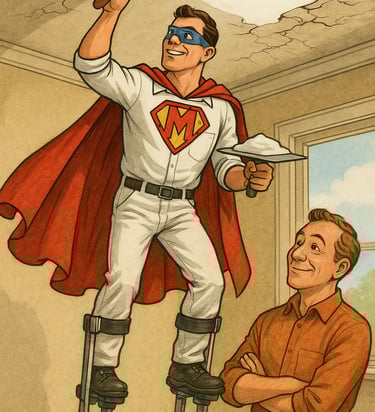


Plaster Crack Repair In Western Massachusetts
MrWalls Drywall & Painting — Western Massachusetts
Plaster Crack Repair In Western Massachusetts
Cracks in plaster walls are one of the most common complaints from homeowners in the Pioneer Valley. Some are cosmetic and easily fixed. Others are telling you something more serious. MrWalls reads the difference and repairs both correctly.
MrWalls Drywall & Painting
·Springfield · Chicopee · Holyoke · Northampton & Beyond
Plaster crack repair is not a job for joint compound squeezed from a tube and sanded smooth in an afternoon. Done wrong, plaster cracks return within a season. Done right, with the correct materials and the correct technique for the specific crack type, a plaster repair in a Western Massachusetts home can last as long as the original plaster around it.
If you live in a home built before 1960 in Springfield, Northampton, Holyoke, Chicopee, Westfield, or anywhere else in the Pioneer Valley, there is a strong chance you have plaster walls. And if you have plaster walls, there is an equally strong chance you have cracks. They appear above doorframes, along ceiling perimeters, across flat wall surfaces, and in the corners of older rooms. Some have been there for decades. Some appeared last winter. Some are growing.
Plaster cracks are not all the same problem. They have different causes, different patterns, different depths, and they demand different repair approaches. The mistake most homeowners make is treating every crack the same way, applying joint compound, painting over it, and watching the same crack return in the same place within a year. MrWalls Drywall and Painting diagnoses plaster cracks correctly before touching them, chooses the right repair method for the specific failure, and produces results that hold up through Western Massachusetts winters and beyond.
Reading Plaster Cracks Before Repairing Them
Every plaster crack tells a story. The pattern, width, location, direction, and whether both edges of the crack are at the same level or one has shifted relative to the other all carry information about what caused the crack and whether the movement that produced it is ongoing or settled. A repair that ignores this information is a repair that will fail.
MrWalls begins every plaster crack assessment by reading the crack before touching it. We look at pattern density, crack width at multiple points, edge displacement, and the condition of the surrounding plaster. We tap the surface around the crack to check for delamination beyond the visible damage. We ask when the crack appeared and whether it has grown. Only after this assessment do we recommend a repair approach, because the correct approach depends entirely on what the crack is actually telling us.
Types of Plaster Cracks in Western Massachusetts Homes
Western Massachusetts homes contain every variety of plaster crack documented in the trade. Here are the most common types MrWalls encounters and repairs across the Pioneer Valley.
Very Common
Hairline Cracks
Fine surface cracks in the finish coat only, not penetrating to the brown coat beneath. Usually cosmetic, caused by normal seasonal movement and paint film tension over decades. Respond well to surface repair when the substrate is otherwise sound.
Very Common
Map Cracking
A network of interconnected fine cracks covering a section of wall in a random web pattern, resembling a road map. Caused by shrinkage of the finish coat or by incompatible layers applied over each other across multiple decades of painting and repair.
Common
Settlement Cracks
Diagonal cracks running at roughly forty-five degrees from door and window corners. These follow the stress lines created by frame movement and foundation settling. Often stable after the initial settling period but require monitoring before repair.
Common
Structural Cracks
Wide cracks, cracks with displaced edges, or cracks that are actively growing. These may indicate ongoing foundation movement, differential settling, or structural loading issues that must be assessed by a structural engineer before any cosmetic repair is attempted.
Common
Ceiling Perimeter Cracks
Cracks running along the joint between ceiling and wall, caused by differential movement between the two planes. Very common in older Pioneer Valley homes as floor joists deflect seasonally. Usually cosmetic but persistent without flexible repair treatment.
Assess First
Cracks with Delamination
Cracks accompanied by hollow-sounding or bulging plaster nearby. The surrounding plaster has separated from the lath and is no longer supported. Repair cannot proceed until delaminated sections are stabilized or removed.
When a Crack Is a Warning, Not Just Cosmetic
Most plaster cracks in Western Massachusetts homes are cosmetic. They are the product of seasonal movement, aging materials, and decades of minor building shifts that have long since stabilized. They look bad but do not indicate any structural concern, and they respond well to professional repair.
Some cracks are different. Wide cracks, cracks where one edge sits higher than the other, cracks that have appeared suddenly and are actively growing, and cracks accompanied by sticking doors or windows in nearby openings may indicate ongoing structural movement that needs to be evaluated before any cosmetic repair is performed. Filling a crack that is still moving guarantees the repair will fail. More importantly, a structural problem left unaddressed behind a cosmetic repair does not stop progressing just because the surface looks better.
MrWalls will not repair a plaster crack that shows signs of active structural movement without first advising the homeowner that the crack should be assessed by a structural engineer or foundation specialist. A cosmetic repair over an active structural problem is not a service we provide. If your crack falls into this category, we will tell you honestly, refer you to the appropriate professional, and schedule the plaster repair for after the underlying issue has been addressed.
How to Tell If Your Crack Is Moving
A simple way to monitor a plaster crack between the time it appears and the time it is repaired is to mark each end with a pencil line and date it. If the crack extends beyond the pencil marks over the following weeks or months, it is active. If it stays within the marks through a full seasonal cycle, it is most likely stable. MrWalls uses this kind of practical observation, combined with physical assessment of the crack characteristics, to determine the correct repair approach on every project.
Why Joint Compound Alone Does Not Fix Plaster Cracks
The most common DIY approach to plaster crack repair in Western Massachusetts homes is to apply premixed joint compound from a hardware store tub, sand it smooth, and paint over it. This works acceptably for very minor hairline cracks in otherwise sound plaster. For anything more significant, it reliably fails within a season, and often sooner.
Plaster is a rigid, dense material. The cracks it develops are responses to movement, stress, or material failure that produced real separation at the crack location. Joint compound is a flexible material with different thermal expansion characteristics from the surrounding plaster. Applied alone into a plaster crack without adequate bonding to both sides of the crack, it dries, shrinks slightly, and either pulls away from the crack edges or cracks again across its own surface when the surrounding plaster moves seasonally.
Professional plaster crack repair uses materials and techniques matched to the specific crack type. Hairline surface cracks may be treated with a flexible bridging primer and skim coat. Deeper cracks require the crack to be opened, cleaned, and filled in compatible base material before a finish skim coat is applied. Cracks with delaminated plaster nearby require the delaminated areas to be re-bonded or removed before any surface repair is applied. One approach does not fit all crack types, and this is precisely where most failed repairs go wrong.
Our Plaster Crack Repair Services
MrWalls handles the full range of plaster crack repair scenarios found in Western Massachusetts homes, from hairline finish coat cracks to full section removal and replastering.
🕸️
Hairline and Map Crack Repair
Bridging primer, compatible skim compound, and finish coat restoration on surface-level crack networks. Matched to surrounding texture and finish.
📐
Settlement Crack Repair
Diagonal and stress cracks at door and window openings opened, cleaned, filled in base coat material, and finished to blend with the surrounding wall surface.
🏛️
Ceiling Perimeter Crack Repair
Wall-to-ceiling joint cracks treated with flexible materials and appropriate technique to resist the differential movement that caused the original crack.
🔩
Delamination Stabilization and Repair
Loose plaster re-bonded using consolidant injection or mechanical fasteners where appropriate, followed by surface crack repair and finish coat restoration.
🏗️
Section Removal and Replastering
Damaged plaster sections removed back to sound edges, lath assessed and repaired, new plaster built up in compatible base and finish coats to match the surrounding wall.
🎨
Prime and Paint Completion
All repaired surfaces primed with appropriate sealer and painted to match existing wall colors. One contractor from crack repair through finished painted wall.
Crack Repair in Western Massachusetts Climate Conditions
The Pioneer Valley's climate is one of the most demanding in New England for plaster. Cold, dry winters driven by the Connecticut River Valley corridor pull moisture out of plaster walls and cause contraction. Hot, humid summers add it back. The freeze-thaw cycle through November, March, and April stresses every material in a building envelope. Plaster walls in Springfield, Northampton, and Holyoke experience the full range of this annually, and the cracks that result are predictable consequences of that stress.
Understanding this climate context is part of what guides repair material selection. A repair compound that is too rigid will crack again with the first seasonal cycle. A repair that is too flexible will not hold its edge. The specific material, application thickness, and surface preparation for a plaster crack repair in a Western Massachusetts home need to account for the environment those walls live in, not just the immediate appearance of the crack. MrWalls brings that environmental awareness to every repair specification.
MrWalls tip: the best time to repair plaster cracks in Western Massachusetts is late spring through early fall, when interior humidity and temperature are relatively stable and joint compound and plaster repair materials can cure at consistent conditions. Repairs made in the dead of winter in a home with forced hot air heat can cure too quickly and shrink excessively. Repairs made in high-humidity summer conditions may cure too slowly and bond poorly. Where repairs cannot wait for optimal conditions, MrWalls adjusts material selection and application technique to compensate.
The MrWalls Plaster Crack Repair Process
Every plaster crack repair MrWalls performs follows a structured sequence, from reading the crack through delivering a finished surface that is stable, smooth, and matched to the surrounding plaster.
Assessment and crack classification. We examine every crack to be repaired, classifying each by type, depth, width, and whether the surrounding plaster is sound or delaminated. We tap the surrounding surface to identify hollow areas beyond the visible crack. This assessment determines the repair approach for each crack before any material is selected or applied.
Delamination identification and treatment. Any hollow-sounding areas within the repair zone are addressed before surface repair begins. Where delaminated plaster can be re-bonded using consolidant injection or mechanical fasteners, we do so. Where the delaminated section is beyond saving, it is removed cleanly and the exposed lath is assessed for condition and repair need.
Crack opening and cleaning. For cracks deeper than the finish coat, the crack is opened slightly with a tool to create a clean, consistent channel that accepts repair material fully rather than bridging over a shallow void. Dust, loose material, and old compound from previous failed repairs are removed. A clean crack accepts a repair that bonds to both sides properly.
Wetting the crack edges. Before any repair material is applied, the crack edges and surrounding plaster are dampened. Dry plaster absorbs moisture from repair compound too quickly, pulling the compound away from the crack edges as it dries and preventing full adhesion. Wetting the substrate slows absorption and allows the repair material to bond properly.
Base material application. For cracks deeper than the surface coat, a compatible base material is applied to fill the crack body, slightly proud of the surrounding surface, and allowed to cure fully. Setting-type compound is used for cracks that require dimensional stability, as it shrinks less than drying-type compound and is chemically compatible with lime-based plaster systems.
Mesh tape reinforcement where appropriate. Cracks that have a history of returning, cracks at stress concentration points such as door and window corners, and cracks that cross a joint or seam in the lath beneath receive a layer of fiberglass mesh tape embedded in the base coat. This distributes stress across a wider area and prevents the crack from propagating through the repair in the same location.
Finish coat application and blending. A finish coat of compatible material is applied over the cured base, feathered out well beyond the crack location to blend the repair into the surrounding wall surface. The transition zone between repair material and original plaster is the area most likely to show if not properly feathered, and MrWalls extends this zone generously on every repair.
Texture matching. Once the finish coat is fully cured, the repaired surface is textured to match the surrounding plaster. Smooth plaster walls receive a troweled smooth finish. Sand-finish plaster receives a matched sand texture. Painted surfaces that have developed a surface texture from multiple paint coats over decades receive a compatible surface treatment that reads consistently under the new paint coat.
Sealing and prime coat. Repaired plaster surfaces are primed with a penetrating sealer appropriate for plaster before any paint is applied. New plaster repair material and the surrounding original plaster have different porosity levels. Without primer, paint absorbs unevenly and the repair shows as a dull spot or sheen variation through the finish coat. MrWalls always primes plaster repairs before paint.
Final inspection under raking light. The completed repair is inspected under a raking light before the project is considered done. Raking light reveals any surface variation, ridge, or texture inconsistency that normal overhead lighting would conceal. If any area does not meet our standard under this inspection, it is corrected before we leave the site.
Preserving Plaster in Older Pioneer Valley Homes
Western Massachusetts has a housing stock that is among the oldest in New England, with significant concentrations of pre-1940 construction in Springfield, Northampton, Holyoke, Chicopee, and the surrounding communities. The plaster walls inside these homes are part of their historic and architectural character. They are denser than drywall, better at blocking sound, more fire-resistant, and thermally more massive. They contribute to the way these homes feel in ways that replacement with modern drywall does not replicate.
MrWalls approaches plaster crack repair in these homes with preservation as the primary goal. Where the plaster is structurally sound and the cracks are surface-level or otherwise repairable, we repair rather than replace. Where sections have failed beyond repair, we rebuild with compatible materials that respect the density and character of the surrounding original system. We do not recommend stripping plaster and drywalling a room simply because crack repair is involved, and we tell homeowners honestly when that is an option being suggested for reasons of convenience rather than necessity.
Why MrWalls for Plaster Crack Repair in Western Massachusetts
MrWalls Drywall and Painting has repaired plaster cracks in homes across Springfield, Chicopee, Holyoke, Westfield, Northampton, Agawam, Ludlow, Wilbraham, Longmeadow, East Longmeadow, and throughout the Pioneer Valley. We have worked on every era of plaster construction found in Western Massachusetts homes, from wood-lath lime plaster in nineteenth-century buildings to transitional gypsum-board-and-skim systems from the 1950s. We know how these systems behave, what their crack patterns mean, and what repair approach produces results that last.
Crack classification before repair, reading pattern, depth, displacement, and delamination to determine the correct approach for each crack type.
Compatible materials used throughout, setting-type compound and plaster-compatible base coats rather than standard joint compound applied over rigid plaster.
Honest structural assessment, cracks showing signs of active movement are referred to the appropriate specialist before any cosmetic repair is performed.
Preservation-first approach, MrWalls repairs sound plaster rather than recommending unnecessary replacement, respecting the character of older Pioneer Valley homes.
Full drywall and painting services available, one contractor handles plaster repair and the final painted finish in a single project engagement.
Licensed, insured, and locally owned, a Western Massachusetts contractor whose work is visible in homes across Hampden and Hampshire Counties every day.
Frequently Asked Questions
How do I know if my plaster crack is structural or cosmetic?
The most reliable indicators of a structural concern are cracks wider than a quarter inch, cracks where one edge sits at a different level than the other, cracks that have appeared suddenly and are actively growing, and cracks accompanied by other signs of movement such as sticking doors or out-of-square window frames. Hairline cracks and fine crack networks in otherwise sound plaster, particularly in older homes, are almost always cosmetic. When in doubt, MrWalls assesses the crack during a free estimate walkthrough and tells you honestly which category it falls into.
Will the repaired crack come back?
A correctly repaired plaster crack using compatible materials and appropriate technique will not reappear at the same location under normal conditions. Cracks that were repaired with incompatible materials, bridged over without being properly opened and cleaned, or repaired while the underlying cause was still active, will return. MrWalls repairs cracks correctly the first time and uses materials chosen for their compatibility with plaster and their performance through Western Massachusetts seasonal cycles.
Is it better to repair plaster cracks or replace the wall with drywall?
For walls with sound plaster and surface-level or moderate cracking, repair is almost always the better choice. Plaster walls provide density, sound blocking, and thermal mass that drywall does not replicate, and replacing them involves significant demolition, debris removal, and reconstruction cost. Replacement is the right answer when large sections of plaster have failed structurally, when widespread delamination makes repair impractical, or when the homeowner has other renovation goals that make rebuilding sensible. MrWalls recommends based on the actual condition of the wall, not on which scope is larger.
How long does plaster crack repair take?
Individual cracks and small repair areas typically require one visit for base material application and a follow-up visit for finish coat once the base has fully cured, usually one to three days later. Larger repair projects involving multiple rooms or section removal and replastering take longer and are scoped individually during the estimate walkthrough. MrWalls provides a clear timeline before work begins and communicates promptly if any condition discovered during repair changes the schedule.
Can MrWalls paint the walls after repairing the cracks?
Yes. MrWalls Drywall and Painting completes the full sequence from crack repair through primed and painted finished wall. We seal repaired surfaces with the appropriate primer for plaster and apply two coats of paint matched to the existing wall color, leaving the room completely finished in one project engagement. Completing the repair and painting through a single contractor eliminates the gap between trades and ensures the paint system is appropriate for the specific substrate.
Serving Western Massachusetts Communities
MrWalls provides plaster crack repair throughout Western Massachusetts, including Springfield, Chicopee, Holyoke, Westfield, Northampton, Easthampton, Agawam, Ludlow, Wilbraham, East Longmeadow, Longmeadow, South Hadley, Amherst, Belchertown, Palmer, Ware, and surrounding communities across Hampden and Hampshire Counties. Whether your home has a single crack above a doorframe or a full plaster wall with decades of accumulated cracking, MrWalls brings the same diagnostic care and craft to every repair.
Contact MrWalls Drywall & Painting
Plaster Cracks That Keep Coming Back?
MrWalls repairs plaster cracks correctly the first time, with materials and technique matched to the specific crack type and the Western Massachusetts climate.
Call or email us today: (413) 302-0640 · Service@MrWalls.Net
Request a Free Estimate ↗
Home | Contact | Offices | Faq | Service Area | Blog | Drywall Finishing | Drywall Taping | Drywall Repair | Plaster Repair | Ceiling Repair | Wall Repair | Drywall Installation | Drywall Hanging | Popcorn Ceiling Repair | Hole in Ceiling | Fix Hole In The Wall | Interior Painting | Knockdown Texture | Water Damage Repair | Drywall Bathroom | Drywall Ceiling | Soundboard | Drywall Patch | Ice Dam Roof Leak | Drywall over Plaster | Drywall Over Popcorn | Skim Coat Level 5 | Popcorn Texture Removal | Drywall Finish Levels | | Refund Policy | Privacy Policy | Terms and Conditions


600 East Main St Chicopee, MA, 01020
203 Circuit Ave n39, West Springfield, MA 01089