

Soundproofing Contractor In Western Massachusetts
MrWalls Drywall & Painting | Western Massachusetts
We Install Walls That Block And Reduce Sound Transmission
Noise between rooms, floors, and units is a solvable problem. MrWalls brings professional soundproofing drywall assemblies to homes and commercial spaces across the Pioneer Valley. Quieter rooms, better sleep, and real acoustic performance built into your walls.
·Springfield · Holyoke · Northampton · Chicopee & Beyond
Sound travels through walls, floors, and ceilings in ways most people never think about until it's 11pm and they can hear everything. Professional soundproofing isn't foam panels on the wall. It's engineered drywall assemblies, decoupled framing, and acoustic sealing that stop sound at its source. MrWalls builds them right.
Noise is one of the most persistent quality-of-life problems in Western Massachusetts homes, and it's also one of the most misunderstood to solve. Whether you're dealing with a noisy upstairs neighbor in a Holyoke multi-family, highway traffic bleeding into your Springfield bedroom, a home theater that's audible three rooms away, or a home office where every conversation leaks into the rest of the house, the solution isn't acoustic foam, thick curtains, or a white noise machine. The solution is a properly built wall assembly.
MrWalls Drywall & Painting provides professional soundproofing services throughout Western Massachusetts. We design and install acoustic drywall assemblies that use mass, decoupling, absorption, and sealing to reduce sound transmission between spaces, delivering measurable, lasting results that cosmetic treatments simply can't match. If you want genuinely quieter rooms, MrWalls builds them.
Understanding How Sound Actually Travels
Effective soundproofing starts with understanding the physics, because most of what's marketed as "soundproofing" doesn't address how sound actually moves through a building. There are four mechanisms at work in every noise problem, and a professional soundproofing assembly needs to address all of them.
⚖️
Mass
Heavier walls are harder to vibrate. Added mass (extra drywall layers, dense board) reduces how much sound energy passes through.
🔗
Decoupling
Breaking the rigid connection between surfaces stops vibration from transferring directly through framing. The single most effective soundproofing technique.
🧱
Absorption
Insulation inside wall cavities converts sound energy to heat. Acoustic batts perform significantly better than standard fiberglass.
🔒
Sealing
Sound, like air, travels through gaps. Acoustic sealant at every penetration, outlet, and perimeter joint blocks the flanking paths that undermine every other measure.
A soundproofing assembly is only as good as its weakest path. You can build a perfect decoupled wall with double drywall and acoustic insulation, and then have an unsealed electrical outlet transmit sound just as clearly as before. Every gap, every penetration, every rigid connection that bridges the decoupled assembly is a failure point. MrWalls addresses all four mechanisms on every soundproofing project.
Who Needs Soundproofing in Western Massachusetts?
Noise problems are more common in Western Massachusetts than most homeowners realize, and they come from a wide range of sources and situations. Here are the most frequent soundproofing applications we address across the Pioneer Valley:
Most Requested
Multi-Family & Duplex Units
Western Massachusetts has one of the highest concentrations of multi-family housing in New England. Noise between units (footsteps, voices, TV) is the most common soundproofing request we receive across Springfield, Holyoke, and Chicopee.
Very Common
Home Theaters & Media Rooms
Containing bass and dialogue within a dedicated media room so the rest of the household (and your neighbors) aren't part of every movie night.
Very Common
Home Offices
Remote work demands privacy. A properly soundproofed home office wall keeps work calls contained and household noise from disrupting video meetings and focus sessions.
Common
Bedrooms & Nurseries
Quieter bedrooms for better sleep. Blocking hallway noise, street traffic, and the sounds of the rest of the household from reaching sleeping spaces.
Common
Music Rooms & Studios
Practice spaces, recording setups, and instrument rooms that need to contain sound. Protecting the household from the music, and the music from outside noise.
Commercial
Offices & Commercial Spaces
Conference rooms, private offices, medical exam rooms, and therapy spaces where speech privacy and acoustic separation are essential to the business function.
The Soundproofing Methods MrWalls Uses
Professional soundproofing isn't just one technique. It's a layered system of methods selected and combined based on the noise problem, the construction type, and the performance goal. MrWalls uses the following proven methods on soundproofing projects across Western Massachusetts:
🔩
Resilient Channel & Hat Track
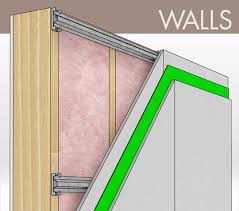
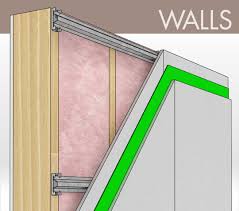
Metal channels that decouple drywall from framing. This is the single most effective technique for reducing airborne sound transmission through walls and ceilings.
📋
Double-Layer Drywall
Adding mass with a second layer of drywall, often with offset seams and damping compound between layers, significantly increases STC performance.
🧴
Damping Compound (QuietGlue)
Viscoelastic damping compound applied between drywall layers converts sound energy to trace heat, dramatically improving performance without added thickness.
🛡️
Acoustic Drywall (QuietRock)
Specialty mass-loaded drywall with built-in damping layers. Delivers high STC performance in a single panel for situations where wall depth is limited.
🌀
Acoustic Insulation Batts
Mineral wool (Rockwool) or dense-pack acoustic insulation filling wall and ceiling cavities, absorbing sound energy within the assembly itself.
🔐
Acoustic Sealant & Gaskets
Sealing every perimeter, penetration, outlet box, and gap with acoustic caulk and gaskets. This closes the flanking paths that defeat every other soundproofing measure.
STC Ratings: What They Mean and What to Expect
Sound Transmission Class (STC) is the standard rating system for measuring how much sound a wall or floor assembly blocks. Understanding STC helps homeowners set realistic expectations for what a soundproofing project will and won't achieve.
STC 25 – 30
Standard Drywall
Typical single-layer drywall on wood framing with no insulation. Normal speech clearly audible through the wall.
STC 35 – 40
Insulated Wall
Standard drywall with fiberglass batt insulation. Loud speech audible but not intelligible. Modest improvement.
STC 45 – 52
Decoupled Assembly
Resilient channel, acoustic insulation, and double drywall. Loud speech barely audible. Most residential soundproofing targets this range.
STC 55 – 65+
High-Performance
Double-stud walls, acoustic drywall, full decoupling and sealing. Near-complete speech privacy. Home theaters, recording studios, commercial use.
Be realistic about STC targets and the construction involved in achieving them. Going from STC 30 to STC 50 is achievable in most existing Western Massachusetts homes with a decoupled drywall assembly. Going from STC 50 to STC 60 requires significantly more invasive construction: double-stud walls, floating floors, and sealed ceiling assemblies. MrWalls will give you an honest assessment of what's achievable within your space and budget before any work begins.
Soundproofing Existing Walls vs. New Construction
The approach to soundproofing differs significantly depending on whether you're working with existing finished walls or building from the framing stage. Both are very achievable. They just require different strategies.
Soundproofing Existing Walls
In an existing finished space, the most effective approach without full demolition is to add a decoupled drywall layer over the existing wall surface. Resilient channel or sound isolation clips are attached to the existing wall, and new drywall is fastened to the channel (never touching the existing wall directly). Acoustic sealant closes every perimeter and penetration, and the result is a meaningfully quieter room that gains only about an inch of wall thickness. It's the preferred method for bedrooms, home offices, and multi-family unit party walls in existing Western Massachusetts homes.
Soundproofing in New Construction
New construction is the ideal opportunity for soundproofing because every technique is available at framing stage, before walls are closed. Double-stud walls, staggered-stud framing, independent ceiling joists, and full acoustic isolation can all be incorporated without the constraints of working around existing construction. MrWalls works directly with builders and general contractors across the Pioneer Valley to incorporate soundproofing assemblies into new builds from the ground up.
MrWalls tip: The single most common soundproofing mistake in new construction is installing resilient channel correctly and then accidentally shorting it out by driving a screw through the channel into the framing behind it. One screw through a resilient channel assembly creates a direct rigid bridge that transmits vibration just as effectively as no channel at all. Our crews are trained specifically to avoid this, and we inspect every fastener location before the job is signed off.
The MrWalls Soundproofing Process
Every soundproofing project MrWalls takes on follows a deliberate sequence, from acoustic assessment through finished, sealed drywall assembly. Here's how we work:
Acoustic assessment and goal setting. We walk the space, listen to the noise problem, and identify the transmission paths (walls, ceiling, floor, flanking routes). Then we work with the homeowner or building owner to define realistic performance targets. Soundproofing that doesn't match the actual noise path is money spent in the wrong place.
Assembly specification. Based on the assessment, we specify the correct combination of techniques (channel type, drywall layers, insulation specification, damping compound if appropriate) to hit the target STC range within the constraints of the space and budget. We present options clearly so the decision is yours to make with full information.
Surface preparation. Existing drywall is assessed for condition. Outlet boxes, light fixtures, and any penetrations that will require acoustic treatment are identified. Any repairs needed to the existing wall surface before the new assembly is added are completed at this stage.
Resilient channel or isolation clip installation. Channel or clips are installed at the correct spacing across the wall or ceiling surface — carefully fastened to the existing framing without bridging the air gap that provides the decoupling benefit. This is the step that requires the most precision and experience.
Acoustic insulation installation (where cavity access allows). Where wall cavities are accessible, mineral wool acoustic batts are dense-packed into the cavity. On existing walls where cavity access isn't available, the decoupled assembly itself provides the primary performance gain.
Damping compound application (if specified). For assemblies incorporating double-layer drywall with damping compound, the first drywall layer is installed and QuietGlue Pro or equivalent viscoelastic compound is applied to the face before the second layer is immediately laminated on top. We work in sections to ensure the compound remains workable throughout.
Drywall installation, without shortcuts. Drywall panels are fastened to the resilient channel only, never to the underlying framing, with the correct fastener length and pattern. Panels are cut short of the floor, ceiling, and side walls so they float within the assembly without creating rigid contact at the perimeter.
Acoustic sealing, every gap, every penetration. Acoustic caulk is applied at every perimeter joint (floor, ceiling, and side walls) before any trim conceals the gap. Electrical outlet boxes receive acoustic gaskets. Any penetrations through the assembly are sealed with acoustic putty pads or backed-out with closed-cell foam. This step is what separates a system that performs from one that disappoints.
Taping, finishing, and texture. The new drywall surface is taped, finished to the specified level, and textured to match the surrounding rooms. A soundproofing assembly that performs brilliantly should also look completely professional. MrWalls delivers both.
Final walkthrough and performance check. We walk every treated surface with the homeowner, confirm all sealing is complete, and do a practical sound test by playing audio on one side and evaluating transmission on the other before signing off on the project.
Soundproofing in Western Massachusetts Multi-Family Homes
The Pioneer Valley's housing stock is distinctive in New England for its high proportion of multi-family homes: triple-deckers, duplexes, and apartment buildings built primarily between 1880 and 1960. These buildings were constructed long before modern understanding of acoustic assembly, typically with single-layer plaster walls on wood lath, minimal insulation, and rigid framing connections that transmit footstep impact and airborne sound readily between units.
For landlords, owners, and occupants of these buildings throughout Springfield, Holyoke, Chicopee, and Northampton, soundproofing between units is both a quality-of-life issue and increasingly a rental value differentiator. MrWalls has extensive experience working in occupied multi-family buildings, sequencing work room by room to minimize disruption, working around tenant schedules, and delivering assemblies that meet Massachusetts building code requirements for party wall construction in multi-family occupancies.
All four acoustic principles addressed: mass, decoupling, absorption, and sealing on every project
Resilient channel and isolation clip expertise, installed correctly without the shorting mistakes that defeat decoupled assemblies
Multi-family building experience, working in occupied Pioneer Valley buildings with minimal disruption to tenants
New construction and retrofit capability, whether that's soundproofing at framing stage or over existing finished walls
Professional drywall finish on every assembly, so the soundproofing performs and looks completely polished
Licensed, insured, and locally owned. A Pioneer Valley contractor accountable to the community we work in
Frequently Asked Questions
Can you soundproof existing walls without tearing them down?
Yes, and it's actually the most common scenario we work in. Adding a decoupled drywall layer over existing walls using resilient channel or isolation clips delivers significant STC improvement without demolition. The wall gains approximately one inch of thickness and the room loses a small amount of floor space, but no existing drywall needs to be removed.
Does soundproofing also help with impact noise, like footsteps from upstairs?
Airborne sound (voices, TV, music) and impact noise (footsteps, dropped objects) require different treatments. Ceiling assemblies with resilient channel and acoustic insulation address airborne transmission from above. True impact noise reduction requires treating the floor above with underlayment, floating floor assemblies, or ceiling decoupling systems. MrWalls assesses which noise type you're dealing with and specifies the correct treatment.
How much wall space do I lose with a soundproofing assembly?
A standard resilient channel assembly with a single added drywall layer adds approximately 1 to 1.25 inches to the wall. A double-layer assembly with damping compound adds around 1.75 to 2 inches. In most rooms this is barely perceptible. In very small rooms or closets it may be worth discussing whether a different approach is more practical.
Will soundproofing one wall make a noticeable difference?
It depends on the noise path. If sound is primarily coming through one shared wall, treating that wall alone delivers a clear improvement. If sound flanks around the treated wall through the ceiling, floor, or adjacent walls, the improvement will be partial. MrWalls always identifies the primary and secondary noise paths before recommending scope, so you know exactly what to expect from the work you're investing in.
Can MrWalls also paint the soundproofed walls when the work is done?
Absolutely. MrWalls Drywall & Painting handles the full project from acoustic assembly through finished painted walls. We match your existing color or apply a new one, leaving the room completely finished, quieter and better looking, in a single engagement.
Contact MrWalls Drywall & Painting
Ready for a Quieter Home?
MrWalls designs and installs professional soundproofing assemblies across Western Massachusetts, from a single bedroom wall to full multi-unit building party walls.
Call or email us today: (413) 302-0640 · Service@MrWalls.Net
Request a Free Estimate ↗
”Very Dependable and fair.”
- Mary from Holyoke MA




”Reasonable price, Excellent experience! I was in a bind and was on a time constraint, and Jason was extremely accommodating and sensitive to my dilemma! The job turned out great! Thank you, Jason!”
- Dianna from Agawam MA
”Great Job, reliable and trustworthy. He comes when he says he will”
- Maureen from Springfield MA
”Jason was friendly and on time. He did a nice job. He was trustworthy in our home. His prices were very reasonable. We are recommend him greatly”
- Susan from Longmeadow MA
Drywall Repair Customer Reviews From Massachusetts
Real Reviews from Google


Home | Contact | Offices | Faq | Service Area | Blog | Drywall Finishing | Drywall Taping | Drywall Repair | Plaster Repair | Ceiling Repair | Wall Repair | Drywall Installation | Drywall Hanging | Popcorn Ceiling Repair | Hole in Ceiling | Fix Hole In The Wall | Interior Painting | Knockdown Texture | Water Damage Repair | Drywall Bathroom | Drywall Ceiling | Soundboard | Drywall Patch | Ice Dam Roof Leak | Drywall over Plaster | Drywall Over Popcorn | Skim Coat Level 5 | Popcorn Texture Removal | Drywall Finish Levels | | Refund Policy | Privacy Policy | Terms and Conditions


600 East Main St Chicopee, MA, 01020
203 Circuit Ave n39, West Springfield, MA 01089